Mats Edén Tellef Kvifte
Knut Kvifte Nesheim
Króta
Taragot
Review by Mike Adcock

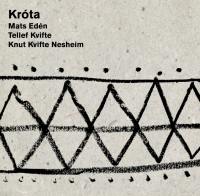
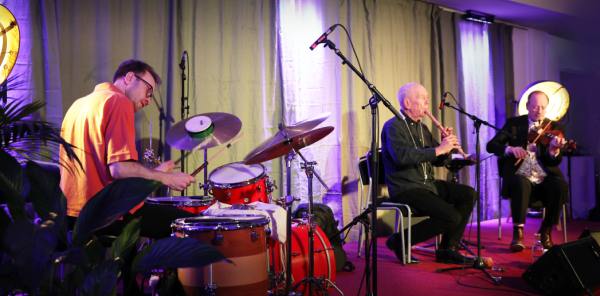
Króta, the latest release on Norway's Taragot label, features a Swede and two Norwegians playing interpretations of mainly traditional tunes from their respective countries. Fiddler Mats Edén has long been involved in Swedish folk music, as a player, composer and teacher, and in the process exploring and integrating different musical styles and approaches. Tellef Kvifte was in the pioneering Norwegian crossover band Slinkombas in the 1970s and has continued to play a central role in Norwegian folk music, both as a musician and an academic. Most often heard playing the sjøfløyte, more widely known as a recorder, Kvifte has employed other instruments from outside the Norwegian tradition, in particular the saxophone and bagpipes. His son Knut Kvifte Nesheim, a drummer and composer, has also shown a determination to blur the lines between different musical genres, both in his solo and group projects.
It comes as no surprise then to find this trio offering a far from conventional take on the tunes they have chosen. While dance tunes may be the source of most of the material here, this feels more akin to chamber music; not that it is remotely classical in style, but in the sense it conveys of three players engrossed in a musically intimate conversation. This is not a performance appropriate for accompanying dancers but might instead be seen as an exploration of hidden possibilities of meaning in the music. In so doing it reveals some of its underlying mystery, including, perhaps, a darker side. Just as in an Ibsen play, where the surface bonhomie, jollity and social nicety can be hiding something more sinister, in Scandinavian dance music there are at times hints of a troublesome undercurrent below the surface. So the decision to open proceedings with “Fossgrimen,” a fiddle tune from Norway's Setesdal valley, is perhaps significant. A fossgrimen is a mythical creature, a kind of water-sprite living in waterfalls from whom fiddle-players were considered to have learned their skills and for that were not universally welcomed, with the fiddle considered to be the devil's instrument.
Tellef Kvifte takes the lead melody on most tracks but on the Swedish “Polska from Per Myhr,” having played a repeated introductory riff on the sjøfløyte, with Mats Edén providing an amorphous textural accompaniment below and Nesheim adding some quiet tinkling, it's Edén who introduces the tune on the fiddle with Kvifte proceeding to play in unison. It's a short track and almost as soon as it gets going things start to fragment and everything grind to a halt.
From the title of "Springar from Knut Nord-Juveli" we learn that it was taken from the repertoire of a renowned sjøfløyte player from Numedal, a valley in the east of Norway and is an appropriate feature for Tellef Kvifte. A springar is a Norwegian triple-beat dance whose three beats vary in length depending on which region of Norway the tune comes from. In this case the underlying pulse resembles that of a rhumba with each bar having two similar beats followed by a shorter one; but the melodic structure is unmistakably Norwegian with a motif being repeated, then the third time through it developing into a variation.
“På Siljan“ was taken from a collection of old Swedish tunes, but the version here is not so much an interpretation as a deconstruction of an item from the Swedish fiddle tradition. Beginning with Edén playing freely, seeking out the resonances of the fiddle through the gentle scraping of the strings with the bow, the tune eventually arrives quietly through the back door, carried by Kvifte on his sjøfløyte while Edén continues to improvise, along with Nesheim playing loosely around his kit. Tellef Kvifte pretty much sticks to the tune, a thread that runs through the track while the other two work around it, creating a rich sound texture, the listener being challenged to decide which is in front and which is behind. An adventurous and worthwhile endeavour which shows once again how traditional music can be not merely a legacy to uphold, but a catalyst for creativity.
Find the artists online.
Mats Edén
Tellef Kvifte
Knut Kvifte Nesheim
Further reading:
Groupa - Kind Of Folk Volume 2: Norway
Guro Kvifte Nesheim and Floating Sofa Quartet - Kystnært
Tellef Kvifte - The Norwegian Bagpipe (?) Vol.2
Subscribe and Support RootsWorld