Pastor Chris Congregation
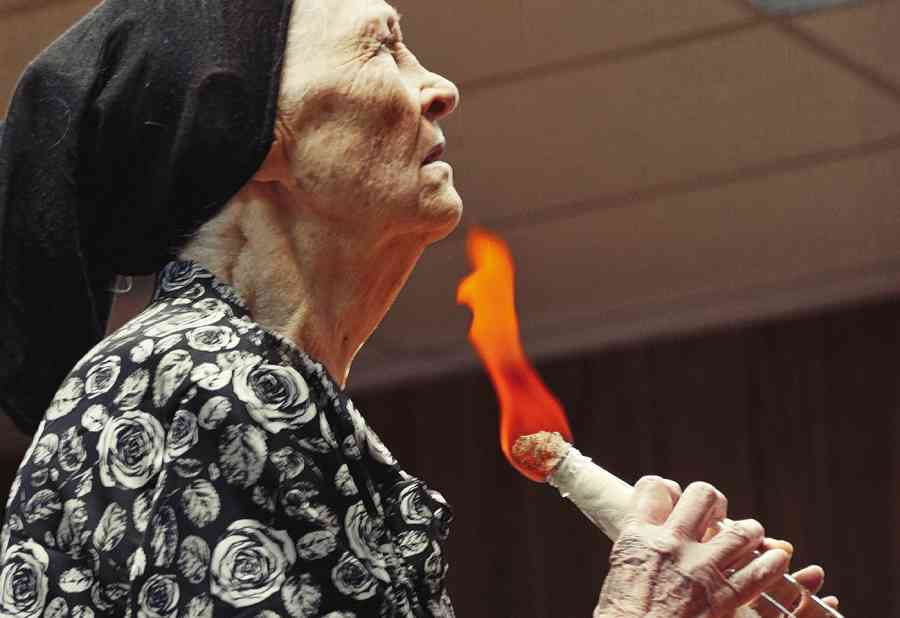
McDowell County West Virginia is nestled in the Appalachian Mountains, and is both stunning and isolated. But, since coal’s heyday has long past, it is also considered the poorest part of the state, if not the entire country. With perhaps as much as 30% unemployment and low average annual incomes, it, like much of the coal regions that surround it, is horrifyingly depressed. It is also overwhelmingly white, and went hard for Trump, boasting the largest support for him in the country in 2016. In 2023, The Guardian ran a photo exhibit on what was designated to be West Virginia’s “last snake handling church.“ The photos, taken at The House of Lord Jesus, in Squire, deep in McDowell County’s claustrophobic, coal scarred southwest, depict stark black and white images of an elderly woman burning a kerosene flame near her face, lots of snakes, and people seemingly possessed as they surrender to a form of Pentecostal practice that uses a quote from Mark 16:18 as their raison d'être. “They shall take up serpents…,” the verse claims. And the church’s members do, sometimes handling groups of venomous rattlers at once, bouncing uncontrollably, occasionally being bit, now and again dying from the poison.
 But in The Guardian’s photo exhibit, there are also occasional shots of a guitar player. And it’s the music, from this very church, that not only accompanies this endangered, radical Christian practice, but which is also the focus of Sublime Frequencies’ West Virginia Snake Handler Revival, the first album the Seattle-based label has ever released featuring music recorded in the United States. Not surprisingly, Ian Brennan, known for recordings of music made by endangered communities all over the globe, produced this record. And despite these folks’ feudal views on homosexuals and women, musically, this is likely some of the most over the top, hypnotic rock and roll transcendence to ever be captured on tape. “He is #1” is the ultimate proof. The track, led by the frantic, in-the-red vocals of Pastor Chris Wolford, features guitars and drums chugging out a monotonous one-chord vamp covered in swamp muck. They chew on that chord, cranking a possessed telecaster-infused, amplified stomp out into the hollers, driving with a stamina that would make Junior Kimbrough proud. Wolford, undoubtedly drenched in sweat, hollers, whoops, insinuates, and punctuates every phrase with “huh,” as is typical for hardcore preachers all over the southern US. At 13 minutes, it’s nearly too much to bear. There’s a reason this is the album’s final track.
But there are plenty of other examples of this album’s disturbing power. The opening track, the one minute “Spirit of God,” features Wolford’s voice, a capella, doused in echo, as if he’s testifying deep within an abandoned mine shaft. “Jesus Has to be #1,” is not unlike the LP’s finale, though it’s much shorter. Here, Wolford screams “Aah Gawd,” and it’s terrifying. Elsewhere, other people sing, with haunted, determined results. The vocalist on “I’m a Lord Jesus Man” is never on key, and the music is better for it. Here is the style of many a 1960s or 70s-era trucker anthem, complete with slithering guitar licks and grooves made for the highway. Later, Wolford returns, exhorting about forgetting to take his ADHD meds and instead getting jacked up on Starbucks. He screams, pants, and grunts, nearly obliterating the wall of electric thrum behind him. Some of the intensity found here is manipulated. The brief track, “Rock and Roll was stolen from God by Satan,” for example, features anonymous testimony over a guitar and drum loop. “Maybe I Won’t Do What I Said I’d Do” loops the title repeatedly over a duplicated demonic laugh for 22 seconds. But by and large, Brennan left the tapes alone, leaving the music’s pugnaciousness be.
Nothing here was created for commercial purposes. Instead, it documents a music that hasn’t budged stylistically in 50 years, rampaging somewhere between hillbilly boogie, and rock and roll choogle. It’s a natural, amplified soundtrack to small congregations of people whose practice has connections to other deep, unyielding trance ritual around the globe, from Gnawa in Morocco, to ecstatic nightclub DJs in Berlin, to the electrified molam that accompanies the Phi Ta Khon festival of ghosts in NE Thailand.
Further reading:
Search RootsWorld
|