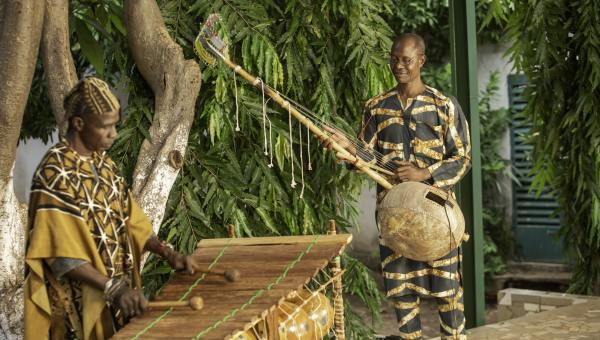
Neba Solo and Benego Diakité
A Djinn and a Hunter Went Walking, released as a double CD, is very much an album of two halves. The recordings made in 2013 of the two musicians playing together were transformed over time into ensemble arrangements with the addition of other musicians playing strings, mellotron, guitar and percussion, plus overdubbed vocals from Solo and three female singers. These reworked tracks make up the first half of the album.
The opening track, “Djinê Mogo Tiki” begins with a capella backing vocals before Diakité introduces a repeated riff on the n'goni over which Solo improvises on the balafon while also taking the lead vocal, a pattern which forms the basis of all the tracks, with the augmented instrumentation creating further layers of interest. “Djinê Mogo Tiki” is one of two tracks to have strings added and these sit well, used sparingly to provide short rhythmic motifs, thankfully belying any fears that might be raised by mention of a string arrangement.
The reinvention of these pieces, clearly done with the co-operation of both Solo and Diakité, may be radical but it has nevertheless been carried out with consideration and musical sensibility. “Yeredon Bali” begins with a few phrases from Solo's balafon, to be joined by Diakité's n'goni, some light percussion and hand claps and then more of the female backing vocals, supporting Solo's vocal in the call and response style characteristic of so much Mande music. In this case the vocal content is the only significant addition to the original duo recording, but significant it is because, in the nature of things, once a vocal line is added that becomes the main focus of attention. What makes the format of this album particularly intriguing is that the final six tracks give us the opportunity of hearing the original, unadorned versions of most of the arranged tracks as first recorded by Neba Solo and Benego Diakité. They are referred to as the “Garden Demos” since they were recorded in a Bamako garden under a mango tree. Without the added vocals the focus shifts to the interplay between the two musicians, and the meaning of the music changes.
For example, we are offered two versions of "Djinê Mogo Tiki," first appearing as the album's opening track in its arranged version, then later in the original duo take. Perhaps this has been done to show two sides of the same story, with an awareness too of differences in what audiences are looking for. The arranged tracks, with their instrumental variety and vocal additions, certainly work well and might help give the music wider appeal. But if you are someone who is captivated by listening to fine players engaged in a musical conversation, eavesdropping on the almost telepathic interaction taking place as the two musicians explore the common ground between them, then it's really already there in the earlier Garden Demos, the final six tracks of A Djinn and a Hunter Went Walking.
Search RootsWorld
|

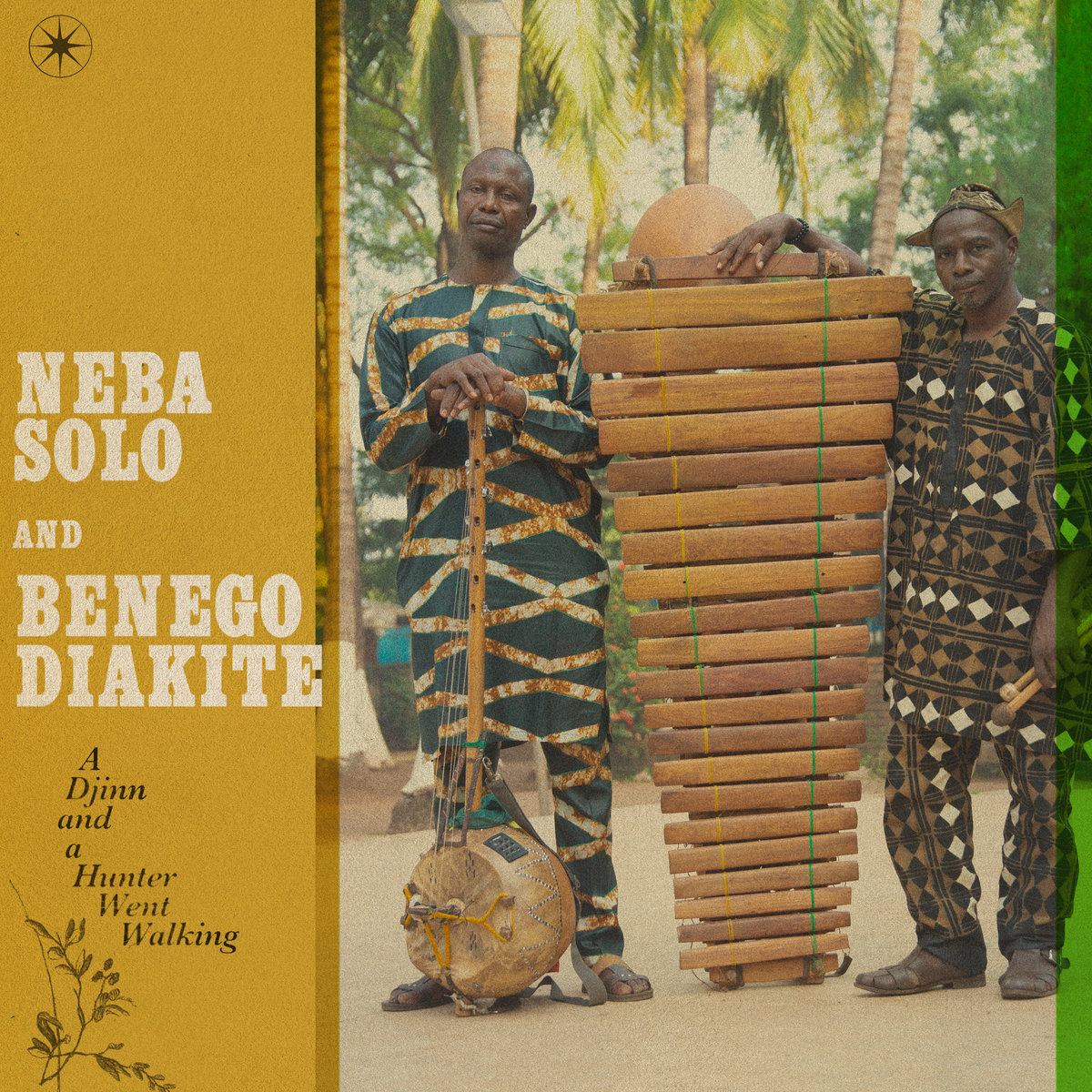 The newly released album from Malian musicians Neba Solo and Benego Diakité is the outcome of a project which began in 2013 when Solo and Diakité, playing balafon and n'goni respectively, were recorded by Bamako producer Ousmane Haïdara. He played the result to another record producer, Nick Gold, who was completely taken by what he heard and together they decided to work on the recording to produce a finished album, also enlisting English musician Sonny Johns to help with the production. Gold had previously brought together Ali Farka Touré and Toumani Diabaté to record what was to become the very successful album In the Heart of the Moon and this was a similar story, Solo and Diakité also being established Malian musicians coming from different musical backgrounds. Indeed, the balafon and n'goni, though both widely associated with Malian music, are seldom played together.