
|
|
|
El Gran Silencio
The first problem with using the term "Postmodern" to describe this musical approach is that the sort of musical mixing that Chuntaros Radio Poder exemplifies is an old, decidedly pre-modern phenomenon. Musicians find it incredibly difficult to resist new ideas and styles, especially when they are in constant contact with those ideas and styles. The standard forms of la musica norteña are a veritable catalog of outside influences on Mexican music: Polkas, Schottisches, and Valses, all European imports of the nineteenth century (by way of the German and Bohemian immigrant communities on the Gulf Coast), and the Cumbia from Colombia (where it had already developed as a blend of African and European forms and rhythms). Until the 1920's the border between Mexico and the United States of America was mostly theoretical, allowing a fairly free flow of ideas, people and goods. So, when El Gran Silencio sings, in "10:00pm – I like to live en mi Tierra:"
The second problem with the term "Postmodernism" is the baggage that comes with it, namely the self-conscious irony with which the term has become almost synonymous, particularly in architecture and design circles. Certainly El Gran Silencio is self-consciously blending styles that seem incongruous at first listen (for instance polka and ragamuffin). They make a big point in their lyrics that "este es el chuntaro style." Many of their lyrics bounce between Spanish and English, with their own peculiarities on both sides of the linguistic equation. However, this self-consciousness does not readily translate into facile irony. The members of El Gran Silencio are not suburban kids playing accordion polkas with a wink, rather they grew up with and demonstrate a profound love of the accordion-based norteño style.
The third, and biggest problem with using the term "Postmodernism" to describe this music is that it takes the discussion away from the music and into cultural theory. The interactions between Mexican culture and Norteamericano culture are fascinating, as are the ways that traditional vernacular musical cultures adapt in order to survive. Chuntaros Radio Poder is a wonderful, thought-provoking example of these interactions. But to focus on this layer of understanding and to miss the sheer beauty and joy of this record would be a shame.
High concept only works when it is executed with equally high craftsmanship. El Gran Silencio, fortunately, possesses that level of craftsmanship, from the noteworthy instrumental and vocal proficiency of the musicians to the brilliant sequencing of the tracks. Of particular note is the accordionist, Campa, who manages to blend his diatonic (presumably the three-row Hohner pictured in the notes) accordion with the disparate styles, without sounding contrived or overbearing.
The quality of the musicianship of El Gran Silencio is matched by the joy and enthusiasm they bring to the music. On tracks like "11:15 pm – Vego en ti" (track 32), where the accordionist is given the opportunity to play fairly long segments of straightforward norteño, they lilt with the best of the genre. They are equally convincing on their excursions into Rock and Roll and the myriad other genres they bounce in and out of.
If Chuntaros Radio Poder has a fault (if it is a fault it is certainly a minor one) it is that in a few places the traditional norteño is placed next to the other styles without a musically logical integration. For instance, "5:30pm – Iguana" is a solid, traditional schottis that could easily be on any hundred norteño record. It is preceded by "4:50pm – Circulo de Amor," a strangely delightful mixture of typical "Radio Romantica" fare with ragamuffin, and is followed by the reggae dance-hall, hip-hop and techno-tinged "5:45 pm – Electronica." All three tracks are good, but the abrupt juxtaposition makes the schottis sound like it is nothing more than a loyalty oath, as if to say, "we really can play this stuff straight!" They prove throughout the record that they have a solid understanding of traditional musica norteña, even with the outside influences; the brief (1:06) selection comes across as a bit gratuitous. But, questions of motive aside, the schottis does provide rhythmic and textural contrast between the other cuts, so perhaps in the context of the whole record it fits.
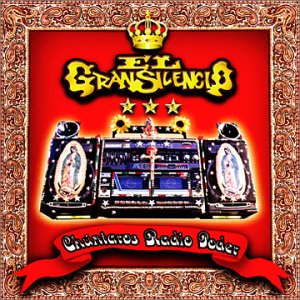
The packaging of Chuntaros Radio Poder also deserves special mention. The aesthetic is completely in harmony with the music: traditional Mexican images (La Virgen de Guadalupe, the Sacred Heart, etc.) blended with urban barrio chic (a highly ornate graffiti style – gothic lettering, airbrush scripts, beautiful arabesques), and typical techno-rave images (line drawings of turntables, stylized drawings of the band members, etc.). The liner notes are particularly detailed, with all of the lyrics printed. The result, like the music, is exciting, varied and surprisingly harmonious.
Some purist norteño fans might object to the strange additions to the repertoire, just as purists may have objected to the rise of the accordion 80 – 120 years ago, when the squeeze box eclipsed the string band tradition prevalent at the time. However, norteño music, in order to survive as a vernacular music, must respond to the music that surrounds it, whether it is the rock and hip hop from the north, the reggae from across the Caribbean, or the musica de tambora from the State of Sinaloa to the west. Vernacular music must undergo periodic revitalization in order to remain a vital part of the people it comes from. Perhaps resistance to outside musical styles will prevail in the end, with the necessary revitalization coming from the lyric content of the narco-corridos. Only time will tell whether norteño can absorb and integrate the styles found on this record. Meanwhile we have a delightful and stimulating artifact of the evolution of this music. - Erik Keilholtz
|
Comment on this music or the web site.
Write a Letter to the Editor
|
|

|


© 2001 RootsWorld. No reproduction of any part of this page or its associated files is permitted without express written permission.