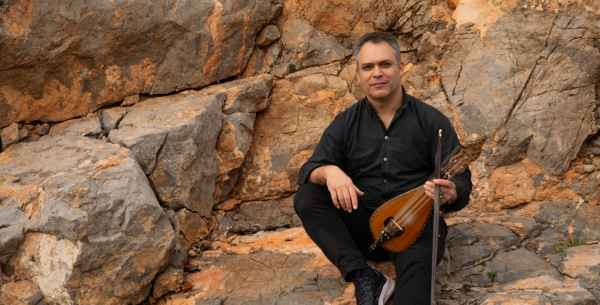
Stelios Petrakis 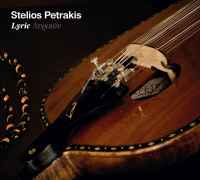 Crete’s Stelios Petrakis is at the peak of players of his island’s best-known traditional instrument, the Cretan lyra, a small pear-shaped fiddle held vertically on the knee. Its three bowed strings are stopped by the fingernails of the non-bowing hand rather than being pressed to the fingerboard. Its sound hovers on the enticing edge between fundamental and harmonics.
Petrakis is also a leading luthier, making the lyras and the other instruments he plays, including the traditional metal-strung lute laouto, and in conjunction with Ross Daly he’s developed and plays a range of lyras with ringing sympathetic strings. True to its title, this an album of his lyra, and laouto, with a panoply of other traditional instruments played by musicians of equal stature to Petrakis, in music of rich lyricism, in melody and texture.
“Astro Sti Gaza” (‘Star in Gaza’), a wish for peace written by Petrakis with lyrics by his brother Yannis Petrakis, opens the album. At first a string drone, then Petrakis’s laouto and lyra, Maëlle Duchemin’s harp, Pavlos Spyropoulos’s double bass, and the percussion of Iranian Bijan Chemirani, who plays frame and flask hand-drums on most tracks. The dark, sinuous instrumental line is tracked by the husky vocal of Giorgis Xylouris, who sings on three tracks, the other six being instrumental. “Nathenas,” a traditional Cretan song in asymmetric rhythms, has a powerful ensemble of lyra, laouto, frame-drum, stick-hit davul, topped out by Breton Sylvain Barou’s reeds and Armenian shvi whistle. “Anglianico,” a stately melody composed by Petrakis, has the tremolo mandolins of Valencian musician Efrén López and Michalis Kontaxakis in an elegant almost orchestral sound with lyra, guitars (Antonis Voumvoulakis and Samuel Mele), Spyropoulos’s double bass, and the accordion of Mattia Marco Gregoriadis on whose improvisation the tarantella-like “Pukanè” is based.
Chemirani is particularly featured on his composition “Panj Pol,” a short finger-rippling, slapping solo on zarb flask-drum whose rhythm is the foundation for the song that it breaks into, “Agrilos,” by Petrakis with lyrics by brother Yannis celebrating the wine-producing district of Crete where they grew up. It develops into a big sound of massed instruments, with a break on frame-drum and Sakir Oran Uygan’s big double-headed davul drum before a surge of squealing tulum bagpipe and other wind instruments from Barou.
“Evlerin Önü Mersin,” a traditional tune from Asia Minor, has a march-like feel, beginning with keening lyra over a slow, inexorable drum pulse, building to soaring epic as more instruments join, peaking with Barou’s zurnas. “Muixeranga,” again with a steady, imposing pulse, is an anthemic tune played in Valencia during the Muixeranga, the traditional building of excitingly high pyramidal human towers in which the big and strong form the bottom layers and the youngest and lightest clamber up to form the topmost. Petrakis intends the track as a message of support to Valencia following the climate-change-driven floods of 2024.
Preluded and accompanied by ringing 3/4 time arpeggiating plucked strings and percussion, with the melody played on lyra, the source of “Nothing Else Matters,” is unexpected: it’s a beautiful version, evocative of memory and perhaps sadness, of a Metallica number.
Further listening:
Search RootsWorld
|