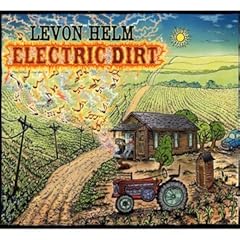
Levon Helm: Electric Dirt
|
Please support this web site with a small donation?
We can't keep it online without your support. Thanks. |


|
Levon Helm: Electric Dirt
|
|
Levon Helm Ronnie Hawkins, the rockabilly bandleader who employed the musicians who later became The Band, gave a wildly indiscreet interview to Rolling Stone in the late 60s in which he recalled the days when his former sidemen were lusty hellions who enjoyed the services of prostitutes. Hawkins particularly relished recounting the exploits of Levon Helm, saying that the singing drummer from Arkansas had such a prodigious member that he wore out the hookers. He even quoted one of the overworked sex workers who had been awed, and exhausted, by Helm's prowess. The Band had just become a top act when the interview came out, and most of them were married. They were mortified by Hawkins' revelations. I was amazed by his candor, which at the time was pretty much unheard of outside the underground press. But the interview also gave me a new perspective on The Band. Not that their music sounded any different to me after reading it. Instead I wondered why these bawdy hell-raisers made such restrained, well-mannered records. Yes, they wrote some great songs and the albums were immaculately arranged and performed. (I also dug that singing Arkansas drummer, whose voice brought an authentic Southern flavor to the majority-Canadian group.) But where was the rock 'n roll wildness, the libidinal energy that they, according to their ex-boss, lavishly expended in their non-working hours? You can probably guess I was never a huge fan. Teenage George was crazy about the incomparably louche and far more exciting Rolling Stones. I basically agreed with Lester Bangs' description of The Band as a bunch of "tight-assed scholars." I recalled that long-ago Rolling Stone interview (guess it made an impression on an impressionable adolescent) while listening to Levon Helm's Electric Dirt, a terrific entry in the hybrid genre/Grammy category dubbed "Americana." Steeped in the blues, R&B, and country, Levon's latest has the sexy swing and earthiness - the funk - that I missed in his old group. So many years after The Band's acrimonious break-up, Helm has made the best record of his career. Electric Dirt is Helm's second outing since his recovery a few years ago from the throat cancer that nearly robbed him of his distinctive country tenor. Its predecessor, 2007's Dirt Farmer, was a fine effort, but more rustic (a little too down home for my taste) and Helm's voice hadn't yet fully recovered from the rigors of cancer treatment. Electric Dirt finds him in better shape vocally and the music is more varied and packs more punch. Produced by Bob Dylan's former lead guitarist Larry Campbell, the album features a number of the musicians who have been playing with Helm at the Midnight Ramble jams he hosts at his home in Woodstock. Besides Campbell, who's on every track, playing guitar but also fiddle and mandolin, and Helms on drums and mandolin, there's Helm's daughter Amy on harmony vocals, bassist Byron Isaacs and keyboardist Brian Mitchell (both of Amy's band Ollabelle), and a horn section arranged by New Orleans legend Allen Toussaint. The songs, nine covers and two new ones, are well-chosen, with a couple of the re-makes superior to the originals. Take "Tennessee Jed," the Jerry Garcia-Robert Hunter number that for many years was a fixture of the Grateful Dead's shows and was released on their Europe 72 live album. It's a great song, but you wouldn't know it from the Dead's rendition -- meandering and rhythmically limp, with a Garcia vocal that's feeble even by his standards. Helms and company take it to New Orleans, with syncopated rhythms, southern fried horns, and Helms' vivid singing. In the Dead's version it plods; Helm makes it strut and stomp. "Tennessee Jed" is a great opener, and most of what follows matches the high standard it sets. On The Staples Singers' gospel-blues "Move Along Train," Helm gets churchy, with daughter Amy and Teresa Williams supplying soulful harmony. Helm and company return to N'awlins for a dazzling take on Randy Newman's "Kingfish," a song so suited to Helm's style, lyrically and musically, that it could've been written for him. Two Muddy Waters numbers, one well-known ("You Can't Lose What You Ain't Never Had"), the other more obscure ("Stuff You Gotta Watch") get countrified, with mandolin, acoustic guitars, and fiddle instead of the stinging electric slide guitar and amplified harmonica that were fundamental to Muddy's sound. But there's no loss of blues power in these salty, spirited interpretations, which, despite having been recorded for Dirt Farmer, belong on its successor. On the other hand, a trio of country ballads -- "Golden Bird," "White Dove," and "Heaven's Pearls" -- would've fit nicely on Dirt Farmer. All three exude a timeless, even archaic rusticity. But "Golden Bird" was written by Happy Traum, the Woodstock-based folk singer, and "Heaven's Pearls" is by Ollabelle, who recorded it a few years ago. Regardless of their provenance, Helm's intimate, plaintive vocals make them all highly affecting. Even someone as generally resistant to country weepies as I can't help but be moved by Helm's rendering of Carter Stanley's "White Dove," a lament for a lost rural Eden ("I'll live my life in sorrow/since mother and daddy are dead"). The one track written by Helm (with Campbell), "Growin' Trade," is the album's most Band-like number; the guitar part makes you think you're going to get "The Weight, Part II." But the story-song is more akin to "The Night They Drove Old Dixie Down." Like that Band classic, "Growin' Trade" is a first-person narrative by a man who's witnessed and must adjust to life-altering change. "Dixie's" Virgil Caine struggled to survive in the aftermath of the Civil War; "Growin's" unnamed narrator has turned to marijuana cultivation as the only way to save his family farm: "I guess you wonder where's the dignity/In a crop you raise to burn/But this land is my legacy/I got no where else to turn." As with everything on Electric Dirt, Helm imbues "Growin' Trade" with deep feeling and conviction; you believe every word he sings. On the cusp of 70, Levon Helm is enjoying a late career resurgence, not unlike another former employer, Dylan, that no doubt will yield more great music. Early in the 21st century, the lusty hellion of the 60s is still a steady rockin' daddy. - George De Stefano The artist's web site: www.levonhelm.com
|
RootsWorld depends on your support. Contribute in any amount and get our weekly e-newsletter.
Thanks for your support of RootsWorld
|
|
|