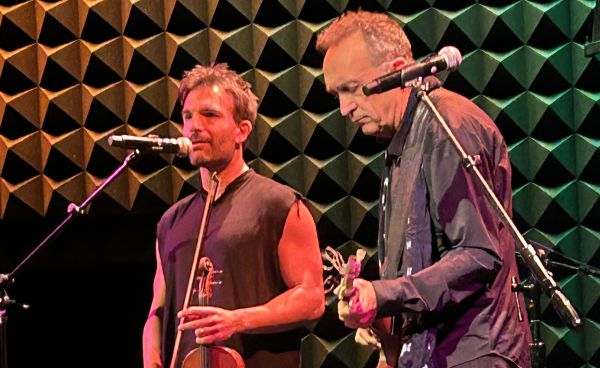
Justin Adams and Mauro Durante serve a pre-Thanksgiving musical feast at Joe's Pub in New York
A versatile British guitarist whose portfolio includes blues, rock, folk, African, and Middle Eastern styles, and a Southern Italian violinist and percussionist with an innovative approach to his region’s traditional music: put them together and you’ve got a soulful and exciting act unlike anything else on the global music scene. Justin Adams and Mauro Durante served a pre-Thanksgiving musical feast at Joe’s Pub in New York City on November 25, 2025, performing tracks from their two excellent albums, Still Moving (2021) and Sweet Release (2024). Both were recorded live in the studio, but in the intimate East Village venue, before an enthusiastic audience, the music became even more expansive and thrilling. Not to mention dramatic, haunting, and beautiful.
Adams, a former member of Robert Plant’s Sensational Spaceshifters and a producer (Tinariwen, Rachid Taha), and Durante, the leader of Canzoniere Grecanico Salentino (CGS), have toured extensively over the past few years. The roadwork has honed the collaboration to the point that their communication is virtually telepathic. The show opened with “Amara terra mia,” an immigrant’s lament made famous by Domenico (“Volare”) Modugno. The song’s narrator bids farewell to his love as he leaves this “bitter land of mine, bitter and beautiful.” Durante’s soaring vocal, plaintive violin, and Adams’ subtle, bluesy accompaniment captured all the pathos of Modugno’s heartbroken lyrics. The rest of the set, a well-chosen mix of tracks from their debut album and its follow-up, included “Sweet Release,” “Ghost Train,” “Leuca,” “Aurora,” “Santu Paulu,” “Tide Keeps Turning,” “Cupa Cupa,” “Ithaca Return,” and “Djinn Pulse.”
Adams doesn’t play long, flashy runs; his style is chordal and powerfully rhythmic on the upbeat numbers, drawing on blues, rock, with a dash of punk aggro. It’s no exaggeration to say he took us to rock guitar heaven. Durante generated so much power and rhythmic complexity on his tamburello that, if you closed your eyes, it was easy to think you were hearing more percussion than one tambourine. There was throbbing bass, dancing cymbals, and snapping snare beats all coming from that small frame drum. New York-based singer and songwriter Felice Rosser joined Adams and Durante for “Tide Keeps Turning,” her deep, bluesy voice more prominent than on the recorded version. “Ghost Train,” a highlight of Sweet Release, stirred together Saharan desert blues, blues rock, and pizzica.
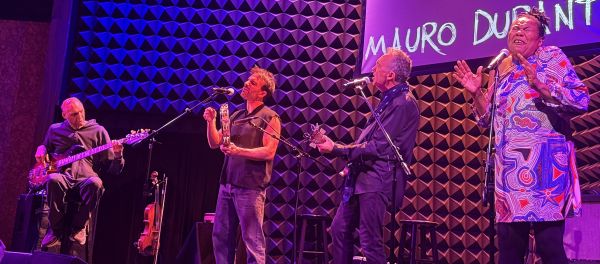 Ismaily, Durante, Adams, Rosser Durante spoke about how easy it was for him to connect with other musicians in New York. He introduced one of them, bassist Shahzad Ismaily, a much-in-demand player whose projects include guitarist Marc Ribot’s Ceramic Dog. He joined the duo for “Djinn Pulse,” an instrumental Adams called “an invocation to summon up the good ghosts.” Ismaily and Rosser returned near the set’s end for “Wayfaring Stranger,” a folk song of unknown origin that has become a staple of Americana. The quartet’s rendition was so affecting that it made me forget my mild disappointment that the set didn’t include “Little Moses,” the Carter Family’s version of a traditional song that Adams and Durante covered on Still Moving. Justin Adams and Mauro Durante, from very different national backgrounds and musical cultures, not only have found common ground; they’ve discovered—and are still exploring— a new sonic world I didn’t want to leave when the set was over.
Find the artists online:
Recording reviews: Interview with Adams and Durante Search RootsWorld
|
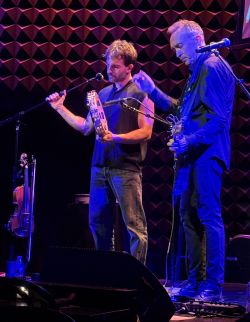 The musicians’ onstage demeanor turned national stereotypes on their head. While the Southern Italian Durante was mostly reserved and intensely focused, turning poetic when he recounted the vision of sea and sky merging that inspired “Leuca,” the Englishman Adams was the extrovert, doing most of the talking, cracking jokes, and making wry comments about music and politics. Adams obviously was having a ball performing this music and was particularly happy to be doing it in New York. Introducing “Tide Keeps Turning,” he paid homage to the city’s Seventies rock scene, its downtown venues and punk and new wave bands.