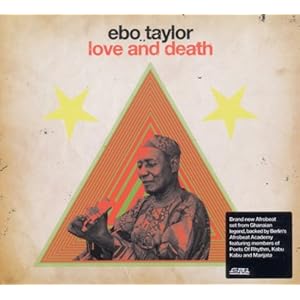
Ebo Taylor - Love and Death
|
If you contribute 5 dollars, RootsWorld survives. |



|
Ebo Taylor - Love and Death
|
|
Ebo Taylor It should seem odder than it does for Ebo Taylor to have reached his 74th year before releasing an album internationally. Yet, no doubt the majority of the international community who are even aware of him owe that consciousness to Mile Cleret and his Soundway compilations Ghana Soundz Vols 1 &2, as well as Analogue Africa’s Afro-Beat Airwaves. For these are compilations of 35 year-old music from West Africa’s recording heyday, released over the last decade and curated by European DJs who manage to find time and cash to scour West Africa for records, dust off recordings by Taylor and others, such as Ghana’s Marijata, find master reels, offer up licensing, painstaking pour over recordings to find just the right track, and aim those tracks straight at westerners. It’s this audience that hears a sonic kinship with North American funk, as well as Nigeria’s Afro-beat superstar Fela Kuti, in much of this music. It’s also unarguably the critical reception these comps have had, sparked by Taylor’s classic tracks, such as “Heaven,” that have helped the producer, arranger, singer, writer and guitarist, who has been a music force in Ghana since his time in the 1960s highlife scene, decide to recapture that sound on Love and Death. And does it ever work. Using Germany’s Afro-Beat Academy as the core of his band, and featuring his own guitar, the tracks nearly sound straight out of the 1970s. Yet, they fortunately don’t feel simply retro. Bands such as the Dap-Tones, the Daktaris, Anti-Balas as well as the Poets of Rhythm, who also recorded a deceptive, heavy funk record in the 1990s as the Whitefield Brothers, manage to re-capture a particular sound but recognize the perpetual relevancy of funk and afro-beat. The arguments about how much, if anything, they add to a musical conversation that reached its Zenith 30-some-odd years ago under masters like James Brown and Fela are complex and frustrating, yet there’s no arguing that Taylor’s band here, with support from members of Marijata, whom he has written for, are up for the task. All but two of the tunes are new and the grooves are secure, percolating and timeless. “African Woman,” with a rhythm driven by a sticks player and a menacing keyboard line, has layers upon layers of tight riffs that manage to make this music still innovative. A remake of an older cut, “Love and Death”, finds Taylor singing in English, his voice slightly awkward, but also warm with age. The horn lines here are classic Afro-beat supporting declarations. It can be a worrisome thing, the idea of a player whose name was made in a style that got pushed aside by soukous, rap and God only knows what other slickly produced styles, suddenly reappearing as past efforts are getting a second look (Nigerian highlife and proto-afro beat pioneer Orlando Julius certainly put out a clunker of a come back LP a few years back). Yet Taylor and company find a way to float one man’s enormous past accomplishments effortlessly into the present. - Bruce Miller
|
RootsWorld depends on your support. Contribute in any amount and get our weekly e-newsletter.
Thanks for your support of RootsWorld
|
|
|